Residential Treatment Program in Florida for Mental Health
Updated LastJuly 1, 2026
Published By:Facility Staff
Residential treatment programs require you to move out of your home and into a residential setting. This type of care may be a good option if you need 24/7 supervision for your mental health condition(s).
Read on to learn more about Mark Behavioral Health’s designed-for-you residential treatment programs for mental health
About Residential Treatment Program in Florida for Mental Health Disorders
Residential treatment for mental health issues involves checking into a hospital, mental health facility, or another type of inpatient setting.
A residential program is best for people who can’t get the recovery results they need with less intense treatment, such as outpatient programs.
Many people confuse residential treatment for psychiatric in-patient care at a hospital since they require patients to live away from home. However, they serve different purposes.
Psychiatric care is for people in crisis who need assistance for a short period, while residential treatment typically involves longer stays.
Key Facts on Residential Mental Health Programs
Duration: Varies depending on the program and severity of symptoms, but usually between 1 to 3 months.
Expected outcomes: Recovery is not guaranteed, but residential programs can help people get the treatment they need to live healthier.
Mental health disorders treated: Depends on the facility and program, but typically include depression and anxiety.
Cost: Depends on your health insurance plan and the length of stay.
Services offered: May include medication management, comprehensive assessments, intensive therapy sessions for people who need constant supervision, family counseling, one-on-one counseling, education around mental health issues.
Residential vs Outpatient Treatment for Mental Health
Mental health treatment programs can be grouped into two general categories: outpatient and residential.
Here is an overview of the differences between these two types of care.
Outpatient treatment programs:
Require you to attend scheduled treatment sessions or day programs, so you can continue living at home and maintaining your schedule.
Provide medication consultation, targeted interventions, and links to community resources such as peer support and social workers.
May be best for people who can manage symptoms with part-time supervision and don’t pose an immediate risk to themselves or others.
On the other hand, residential treatment programs:
Provide 24/7 care and monitoring.
Require you to move into another place, such as a hospital or mental health facility.
May be best for people who pose a significant risk to themselves or others and need 24/7 supervision from licensed mental health staff.
Outpatient and residential programs can both be great ways to support people undergoing a mental or behavioral health crisis. Talk to Mark Behavioral Health to learn more about which program is best for you.
Mark Behavioral Health’s Residential Treatment Program in Florida
Residential treatment at Mark Behavioral Health in Florida entails long-term care of 30 days or more in an inpatient setting, crisis stabilization, therapy, counseling, case management, and more.
Going through our residential treatment program will teach you how to manage your mental health issue(s) for a long period of time.
List of Residential Treatment Program Services
Residential treatment services at Mark Behavioral Health are tailored to meet individual needs.
Here are some of the services we offer:
Crisis stabilization and de-escalation are short-term techniques that reduce potential damage to someone affected by a crisis, such as being diagnosed with a severe illness, violence, divorce, and a family member’s death.
Trauma-informed care (TIC) is a human service approach that works to address your history of trauma. We practice TIC by embracing healing and recovery environments and avoiding practices and services that could re-traumatize our guests.
Sexual abuse care and therapyhelps people who have experienced sexual abuse and assault. Subtypes include psychodynamic psychotherapy, trauma-focused cognitive behavioral therapy (TF-CBT), and eye movement desensitization and reprocessing (EMDR).
Dialectical behavior therapy (DBT) teaches you two strategies: accepting that your behaviors and emotions are valid and making positive changes to manage emotions.
Cognitive behavioral therapy (CBT) is a type of psychological treatment that has been shown to be effective for a range of problems, including anxiety and depression.
Psychoeducationis a therapy program that empowers you and your loved ones by teaching you about mental health symptoms and available treatment options.
Nutritional counselinginvolves a dietician or nutrition expert giving advice about meal planning and building a healthier and more balanced lifestyle.
Grief therapyhelps people after a major loss. It is called bereavement counseling when helping someone cope with the death of a family member.
What Types of Mental Health Issues Can Be Treated in Florida Residential Programs?
A wide range of mental health issues can be treated in residential programs. These include the following:
Talk to Mark Behavioral Health to learn more about how we can help you and your loved ones.
What to Expect During a Residential Mental Health Treatment Program in Florida
Residential mental health treatments depend on the facility and program you choose. Here’s what to generally expect during residential treatment for mental health.
1. Initial Crisis Stabilization
First, if you are in crisis, you will be checked into the residential facility. The staff will then help de-escalate people who are in crisis due to grief, suicidal ideations, and severe mental illness.
2. Designing a Treatment Plan
The staff will then create a treatment plan based on your individual treatment needs. For example, some may need grief therapy, while others may need therapy for sexual abuse and nutritional wellness.
You will work with treatment providers to find a plan that addresses the root of your substance abuse and integrate treatments that will give you the skills and tools to manage the disease.
3. Counseling, Support Groups, and Therapy
Next, you will receive counseling, support groups, and therapy tailored for your needs. These may include:
Individual (one-on-one) therapy
Group therapy
Family therapy
Sexual abuse therapy
CBT
DBT
Your treatment provider will tell you what to expect in advance. They will also talk to you about the types of treatment, recovery support, and follow-up treatments you’ll receive.
4. Relapse Prevention Planning
Finally, your treatment provider will plan to prevent relapse (i.e., the re-emergence of symptoms that had been in remission or the worsening of certain symptoms).
This plan will inform you and your treatment providers how to proceed if and when relapse happens.
What to Expect After a Residential Treatment Program in Florida
After residential treatment, some people may need to move to intensive outpatient or partial hospitalization care.
Some may also need to find a sober living home or residential treatment center. Others may join local support groups to plan for life after treatment.
Mark Behavioral Health’s Florida treatment team can help you and your loved ones plan for life after rehab and set you up for lasting recovery success.
Eligibility for a Residential Treatment Program in Florida
A wide range of people can benefit from and are eligible for residential treatment programs. These include people with:
Severe mental health issues who require inpatient care
Co-occurring disorders or dual diagnosis
Substance use disorders, such as opioid addiction, drug cravings, drug abuse problems, and alcohol addiction
Drug withdrawal symptoms
Ongoing medical or mental health monitoring
Medication management
Intensive therapy for an extended period
Examples of eligible people include those with major depression, suicidal ideations, and individuals who cannot best bipolar disorder or personality disorder episodes.
How a Residential Treatment Program in Florida Lends to Lasting Mental Health Recovery
People who get into and remain in treatment facilities for a sufficient period of time are more likely to see positive recovery outcomes, including a lower chance of relapse.
This is particularly true with residential or long-term inpatient treatment, where people spend consecutive days in treatment and focus solely on learning to manage their disease.
Research has shown that people who attend residential treatment tend to experience improvements in mental health, substance use, and broader social outcomes.
How Much Will Residential Mental Health Treatment Cost?
Residential mental health treatment costs vary depending on your chosen program, facility, and mental health condition(s).
Unfortunately, residential mental health treatment costs are not always the cheapest. There are also other reasons why people often struggle to get the treatment they need.
According to Access to Care Data 2022, 24.7% of all adults with mental illnesses said they could not receive the treatment they needed due to no or limited coverage, insufficient finances, lack of available treatment types, and an undersized mental health workforce.
Fortunately, Mark Behavioral Health is here to help if you or a loved one need mental health treatment. We work with patients and their loved ones to find payment solutions.
How to Find Mental Health Residential Treatment Programs in Florida
There are many mental health residential treatment services for Floridians. Here are some to get you started:
Crisis Text Line: Type “HELLO” to 741741 to talk to a crisis counselor. This text line is available 24/7.
988 Suicide & Crisis Lifeline: Chat 988lifeline.org/ or call or text 988 for help if you or a family member are struggling with mental health.
Veterans Crisis Helpline: If you or a loved one are a veteran with mental health struggles, call 1-800-273-TALK (8255) and press 1 or text to 838255 or to contact a trained responder. The service is available to all veterans, even those who are not registered with the VA or enrolled in VA healthcare.
Hope for Healing provides resources about drug and mental health disorder treatments and treatment links.
To learn more about residential treatment for mental health treatment in Florida, contact Mark Behavioral Health. Our team will listen to your story and help you on your journey to long-term recovery.
How to Begin Our Residential Treatment Program in Florida
Starting your recovery journey with us involves:
Call Us: Reach out to our admissions specialists.
Insurance Check: Free benefits verification.
Clinical Assessment: Determining the right care for your needs.
Admission: Travel planning and seamless intake process.
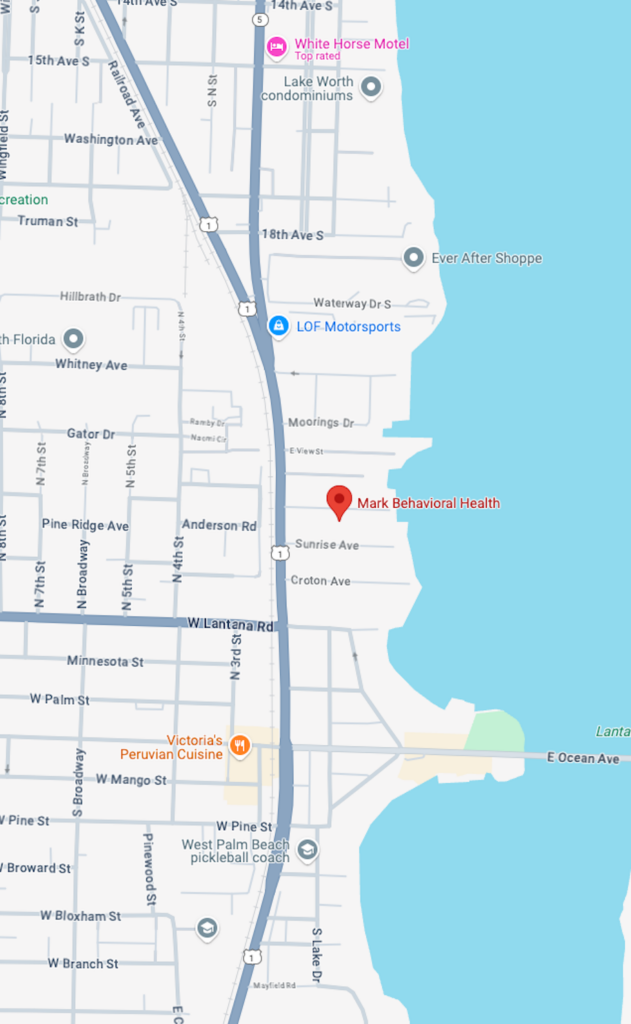
Finding Our Lantana Facility
Our stunning facility is located at 128 Lakeview Ave, Lantana, FL 33462.
We offer wheelchair accessibility and ample parking to ensure your visit is comfortable and stress-free.
Find Quality Residential Care for Mental Health
Finding and paying for quality residential care for mental health can be challenging, especially if your insurance doesn’t fully cover the services you need.
That’s where Mark Behavioral Health comes in. We will work with you to ensure you and your family can pay for the best quality residential care for mental health.
Call us today to learn more about our evidence-based treatment programs for mental health issues. No matter what you’re facing, we can help you design a made-for-you treatment plan and get on the path to healing.
How long is residential treatment for mental health in Florida?
The length of residential treatment for mental health depends on the severity of your symptoms and conditions, but usually lasts 30 days to 12 months.
How to pay for residential mental health treatment?
You can pay for residential mental health treatment out of pocket (if possible) or through your insurance. Mark Behavioral Health will work with you to ensure you get the treatment you need.
Will insurance cover residential programs for mental health?
Some insurance plans cover residential programs for mental health, while others don’t. Talk to your insurance and Mark Behavioral Health to see whether your insurance covers our residential programs.
How do you get admitted into a Florida residential mental health treatment program?
You can get admitted into a residential mental health treatment program after you’ve been assessed by a facility. If the assessment reveals that you need residential mental health treatment, you can be admitted into a program.
Talk to Mark Behavioral Health to learn more about admissions.
Why would someone be admitted to an inpatient mental health facility?
A person may be admitted to an inpatient mental health facility when they can’t get the 24/7 monitoring and support they need through an outpatient program.
Talk to Mark Behavioral Health today to see if inpatient services are a good choice for you or a loved one.
Can you bring your pet to a residential mental health treatment center?
Some residential mental health treatment facilities allow pets, while others don’t. Call the mental health center you’re interested in for more details.
Sources
CAMH. “Dialectical Behaviour Therapy (DBT).” Retrieved February 24, 2024 from
National Library of Medicine: PubMed Central. Schizophrenia Bulletin. “Psychoeducation: A Basic Psychotherapeutic Intervention for Patients With Schizophrenia and Their Families.” Retrieved February 24, 2024 from